
Demystifying Reporting to Understand Your Sustainability Impact
In an era where environmental and social issues are at the forefront of global discussions, businesses, investors, and consumers are increasingly demanding that organizations take responsibility for their impact on the world. Sustainability reporting has become a critical tool for organizations to determine and communicate these impacts, both positive and negative, with stakeholders and the public. However, the landscape surrounding sustainability reporting can appear complex and intimidating, presenting a daunting challenge for sustainability managers.
In this blog post, we'll help you make sense of the reporting landscape and dive into how one of the most widely used global sustainability standards can be used to help you uncover your sustainability impacts.
Why Sustainability Reporting Matters
Before we look at specific reporting standards, it’s important to understand why sustainability reporting should matter to organizations of all industry and size.
These are just five reasons why we believe sustainability reporting is important:
- Transparency: Sustainability reports enhance transparency, enabling stakeholders to make informed decisions about their engagement with a reporting company. Transparency also encourages trust and helps build stronger relationships with consumers, investors, and other important organizational stakeholders.
- Risk Management: Sustainability reporting requires organizations to identify and address ESG risks. Beyond report creation, this commitment to the identification of risk and opportunity can help companies mitigate potential issues and safeguard their long-term viability.
- Reputation and Branding: Demonstrating a commitment to sustainability can enhance an organization's reputation and brand value. The Sustainability Gap Index Report has shown that there are billions of dollars to be gained through improved ESG action and communication!
- Regulatory Compliance: Sustainability reporting is increasingly becoming mandatory due to government regulation and stock exchange requirements. Aligning with global reporting standards early can help prepare for region-specific regulations in the future.
- Access to Capital: Investors increasingly consider ESG performance when allocating capital, making sustainability reporting a crucial aspect of attracting investment.
Global Sustainability Reporting Frameworks
Luckily, you don’t have to create sustainability reports from scratch— there are detailed guidelines you can follow to ensure you’re on the right path to identifying your sustainability impacts and communicating them with the world. However, the “alphabet soup” of acronyms surrounding reporting can be confusing and discouraging. Let’s briefly review some of the most talked about sustainability frameworks to provide some clarity:
- Global Reporting Initiative (GRI): The GRI Standards are the most widely used framework for sustainability reporting, and provide specific guidelines for reporting both the positive and negative impacts an organization has or could have on the environment, economy, and people.
- International Sustainability Standards (ISSB): The ISSB Standards were created by the International Financial Reporting Standards Foundation (IFRS), an accounting and sustainability reporting organization that consolidated several other major reporting standards (including SASB, IIRC and CDSB) in 2022. The ISSB standards are focused on meeting the information needs of investors, and sustainability disclosures are centered on financial risks and opportunities.
- Task Force on Climate-related Financial Disclosures (TCFD): The TCFD provides guidance on disclosing climate-related financial risks and opportunities. It is aligned with ISSB, though slightly more generalized and less granular.
- Carbon Disclosure Project (CDP): CDP is important acronym in the world of sustainability transparency, but is actually not a reporting standard or framework. It is a platform and rating system for reporting and scoring an organizations’ performance on sustainability issues such as carbon emissions, water usage, and deforestation.
- United Nations Sustainable Development Goals (SDGs): Probably the most recognizable to the public, the United Nation’s SDGs are a collection of seventeen interlinked objectives designed to serve as a "shared blueprint for peace and prosperity for people and the planet, now and into the future.” Some organizations choose to align their sustainability reporting with the SDGs, though the SDGs themselves are not a reporting framework.
- The Corporate Sustainability Reporting Directive (CSRD): CSRD is a legislation in the European Union that took effect in January of 2023, and requires organizations to report both on the environmental and social impact of their business as well as business risks and opportunities related to ESG initiatives. Though this legislation is specific to the EU, it’s impact is being felt worldwide, and it builds heavily upon both the GRI and ISSB standards.
How these reporting frameworks relate to one another
One of the primary challenges to sustainability reporting globally is the standardization of reporting on something as broad as sustainability at an international level. Over the past several decades there has been a proliferation of organizations dedicated to solving the problem of standardization. Though well-intended, this increase in sustainability reporting frameworks and organizations lead to confusion and complaints from organizational leaders who found it impossible to navigate an increasingly complex reporting landscape. In recent years many of these organizations have been consolidated in order to make the reporting more manageable. Most notably, the International Financial Reporting Standards Foundation (IFRS) has consolidated several standards, including SASB, IIRC, and CDSB.
Here is a visual to help you understand the relationship between existing frameworks and organizations:
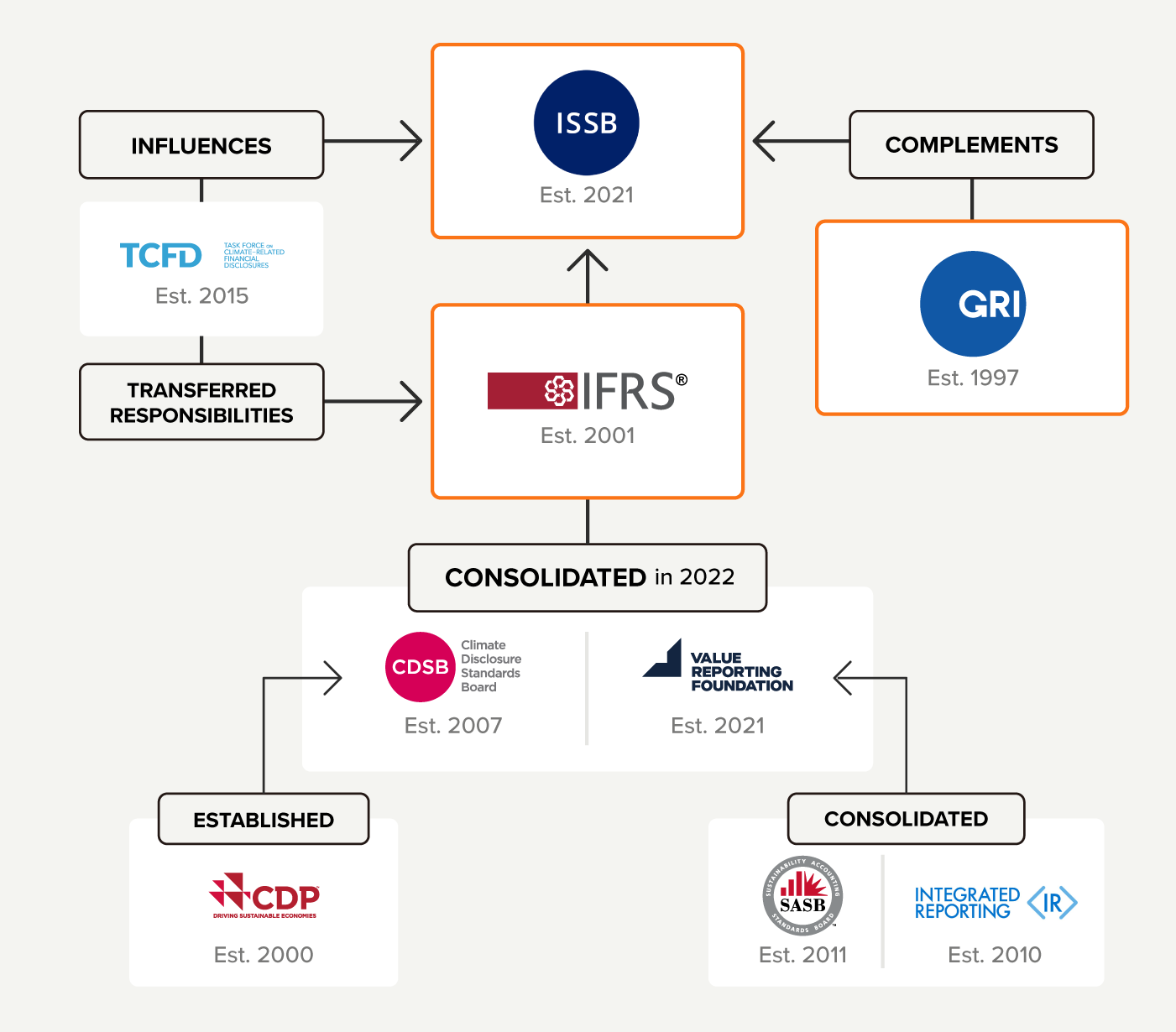
It is important to note that GRI is not one of the organizations consolidated into the IFRS and instead serves as an influence and a complement to the ISSB standards. This is because these two standards serve different but important needs.
While the ISSB focuses on the needs of investors when it comes to sustainability related financial risk and opportunity, GRI standards focus more broadly on the impact an organization has on the environment, economy, and people. This information is valuable not only to investors, but to the wider network of stakeholders surrounding the organization, including workers on the supply chain, local communities, NGOs, governments, and more.
Understanding the most widely used sustainability reporting framework — the Global Reporting Initiative (GRI)
The GRI Standards stand out as the most extensively adopted among sustainability reporting frameworks, utilized by over 10,000 organizations from more than 100 countries (GRI) and they serve as a great foundation when getting started with sustainability reporting as well as for understanding your organization’s impact.
Born out of the aftermath of the devastating 1989 Exxon Valdez oil spill, GRI was established in 1997 to address the global demand for a robust system ensuring businesses' accountability in sustainability practices. The GRI Guidelines G1, released in 2000, were the world’s first sustainability reporting standard. The GRI Standards have since been published and revised, and the GRI continues to work in collaboration with other major accounting and sustainability guidelines to ensure their vision of “a sustainable future enabled by transparency and open dialogue about impacts”.
Key Components of the GRI Standards
The GRI Standards are a modular system consisting of three main parts: Universal Standards, Topic-specific Standards, and Sector Standards.
- Universal Standards: These are the core principles that underpin GRI sustainability reporting. They cover essential concepts such as materiality (identifying and reporting on significant topics), stakeholder inclusiveness (engaging with a wide range of stakeholders), and completeness (ensuring comprehensive reporting).
- Topic-specific Standards: Topic-specific standards offer detailed guidance on specific sustainability topics such as greenhouse gas emissions, water use, labor practices, and human rights. Organizations select the standards that are most relevant to their business and objectives, and can use the topic-specific standards to determine the metrics they should be tracking and reporting.
- Sector Standards: In addition to the universal and topic-specific standards, GRI has developed sector-specific guidelines for various industries. These standards help organizations in specific sectors report on issues that are particularly relevant to their industry. These standards are still under development, and new sector standards are released regularly.
These three continually updated standards work together to create a comprehensive and flexible reporting framework.
Using GRI to Identify and Share Impact
Beyond providing a framework for reporting, the GRI Standards also serve as a tool for discovering and understanding your contributions to sustainable development.
The GRI definition of an impact is “the effect an organization has on the economy, the environment, and/or society, which in turn can indicate its contribution (positive or negative) to sustainable development.” (GRI) As GRI certified sustainability professionals, Neuromagic refers to the GRI standards when helping organizations identify their impacts on the environment, economy, and people.
These are several reasons why the GRI Standards as a great starting point for sustainability transformation and sustainability reporting:
- A Comprehensive Framework: One of the standout features of GRI standards is their comprehensiveness. They provide a detailed framework for organizations to report on various ESG aspects, covering everything from greenhouse gas emissions and labor practices to human rights and supply chain management. This thorough approach ensures that organizations don't leave any stone unturned when assessing their sustainability performance.
- Stakeholder Inclusive: GRI standards emphasize stakeholder inclusiveness, encouraging organizations to engage with a wide range of stakeholders to understand their concerns and priorities. Rather than focus only on investor needs, GRI encourages consideration for all stakeholders, including local communities and workers along an organizations’ supply chain.
- Globally Recognized: GRI standards are recognized and used worldwide, making them a universal language for sustainability reporting. This global recognition facilitates benchmarking and comparisons across industries and regions, and can also help ensure compliance to future regional standards that are modeled around GRI.
- Sector-Neutral: GRI’s universal and topic standards are sector-neutral, meaning they can be applied across various industries. While different sectors have their unique challenges, GRI standards offer a baseline for all organizations. This sector-neutrality ensures that no matter the industry, the fundamentals of sustainability reporting remain consistent. Sector standards are also under development which can be referenced when sector-specific information is required.
- Adaptable and Scalable: GRI standards are adaptable and scalable. Organizations can select the specific topic standards that are most relevant to their operations and objectives, making the GRI standards suitable for businesses of all sizes and industries.
- Applicable to other standards: Most global standards can work hand-in-hand with GRI reporting. In particular, IFRS encourages using GRI standards along with IFRS standards a newer regional standards, like CSRD in Europe, are built in alignment with GRI. So, if you start your reporting journey with GRI, you can seamlessly transition or add to your reporting based on organizational and stakeholder needs.
Conclusion
Sustainability reporting might seem complex and overwhelming at first. However, it's crucial to recognize the significance of sustainability reporting across all industries and sizes of organizations and determine which standards fit your organizational needs. Embracing sustainability reporting, particularly through the GRI Standards, not only aids organizations in understanding their impact but also empowers them to engage in meaningful dialogue, foster transparency, and contribute significantly to a sustainable future for all.
If you’re interested in learning more about uncovering, tracking, and reporting your sustainability impacts, feel free to reach out to us at Neuromagic. Through workshops, research and consulting, we support clients to identify the key sustainability issues unique to their organization. With a GRI certified sustainability professional on our team, we ensure outcomes that are aligned with global standards while also customized to the specific needs of your unique organization.
Once you have an understanding of the key sustainability issues within your organization, we can also help you track your sustainability impact with sustainability data management platform, SustainLab. SustainLab allows organizations to centrally and efficiently manage, upload, analyze, and report sustainability data. Built by European sustainability leaders and AI data science experts, SustainLab leverages cutting-edge technology in a practical, easy-to-use interface.

More in this category
Why Japan’s “Business as Usual” Doesn’t Always Translate: Part 3 — Bringing Sanpō Yoshi into Management
Sustainability Strategy
Why Japan’s “Business as Usual” Doesn’t Always Translate:Part 2 — Why Japanese Companies That Have Long Valued Nature Are Now Grappling with Natural Capital
Sustainability Strategy
World Ozone Day: Turning Environmental Change into Business Opportunity
Sustainability Strategy